The walls of Trevi are nearly intact. Both route and construction material clearly differentiate the original fortification (the castrum or Roman fortified camp) from its medieval enlargements.
The oldest part of the walls comprises those that still today form the boundary of the town to the west; very substantial remains can also be seen, however, in the Via del Fiscale, the Via Fantosati and in the last stretch of the Via S. Francesco. The remainder of the walls has been incorporated into later buildings, and in the deeper recesses of certain houses vestiges of them can be clearly identified: above the Via S. Francesco, in the Via della Fonderia and in the compound of the former monastery of S. Bartolomeo.
View of the Roman walls
A powerful Roman work datable to the 1c B.C., these walls form a more or less circular circuit around the top of the hill, or to put it better, a polygonal enclosure with something like 16 to 18 sides. Built as a compact curtain wall, it is of variable height depending on the terrain, and about two meters thick at the base; it has neither loopholes nor towers.
The Porta Nova, or New Gate.
The material used, a solid local limestone and a lime mortar produced by heating that same stone, has so firmly amalgamated under the effect of rainwater that in some places one can no longer tell where the stone ends and the mortar begins.
Three gates have been identified as part of the Roman wall.
The main square — now called Piazza Mazzini — was outside the walls, as is rather frequently the case with very ancient fortified towns. The first medieval extension of the walls was toward the east, in order to take in, precisely, the area of the piazza all the way through to the flat space that now forms the Piazza Garibaldi, where a moat (the “Lago”, literally the Lake) was dug to defend the more vulnerable parts of the wall.
Around the mid-thirteenth century two further extensions, southwestward toward the valley, gave the town of Trevi the shape it still has today. All the damage done to the walls was the work of the century just now behind us. The most important of the vanished segments faced onto the Piazza del Mercato (today’s Piazza Garibaldi) and was demolished in 1910, whereas the breach on the south side was made in the 70’s in order to allow car access to the Piaggia neighborhood. Another small breach also opened up at about that time: the old
gate of S. Fabiano
, which had stood unused since time immemorial, finally collapsed through neglect, and was then despoiled of its stone.
But this complex monumental work, on the construction and maintenance of which great care has been lavished by the people of Trevi over the centuries, now requires a systematic plan of both routine and special maintenance, if the normal wear and tear of time and the deplorable effects of human neglect are to be prevented from causing it to be irretrievably lost within a very few decades.
Remains of the powerful triangular Torrione della Neve or ‘Snow Bastion’.
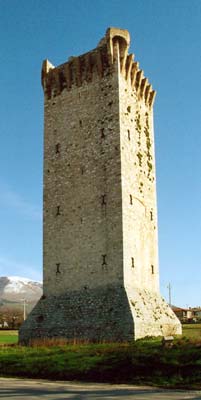
A witness to the restless and bloody struggles among the townships during the Middle Ages, the tower rises imposingly by the side of the Via Flaminia: a powerful instrument of defense, but also a striking demonstration of the power of the comune of Trevi.
The many commercial and industrial buildings that have recently sprung up around it have sapped much of the menacing grandeur that it had up to the middle of last century.
Old folk still remember truculent tales of brigands who conducted their nefarious enterprises in this place. The solitude of the place and the disquieting, enigmatic lack of any door by which the interior might be accessed (no one has ever seriously looked for the underground entrance, and if anyone found something during the construction of those new buildings, they certainly never spread the word about) gave rise to many fearful tales and continue to feed them today.
The tower was recently consolidated after the 1997 earthquake.
The tower seen from the NW- photo 2/24/2004
n.670-16c
The events that led to its construction and the importance it had in past centuries are well described by the following article, excerpted from:
To the east of the Via Flaminia, the ancient Roman road, about halfway between Foligno and Trevi, rises this interesting monument, arresting the attention of the traveller, and keeping alive for us and for others a legend of fearful events, of horrendous assaults and murders committed nearby.
We find many interesting memories of the tower in our own archives, the Archivio delle Tre Chiavi. On September 28, 1392 a certain Angelo del Medico proposed to the City Council of Trevi that in order to defend against malefactors who lurked in the environs day and night, committing all sorts of crimes, a huge fosse or ditch be dug on the lower slopes of the mountain of Matigge with a well-constructed tower, and that three good men vested with full legal powers — tres bonos et legales homines — be put in charge of the work. And in fact on December 29th of that year Manente di Petruccio, Ser Angelo del Medico and Ser Andrea di Ser Nuccino were duly appointed.
They did not, however, set to work right away, and the Council had to insist that they be requested to do so. To facilitate the work Del Medico was given the right, on November 1, 1393, to exact a sort of forced loan from the inhabitants of Matigge (imponere prestantiam) to be paid back to them by discounts on their regular taxes in the future (in successivis dativis).
So the required equipment and material were gathered together, but by the end of 1394 the work had not yet started; and on December 18th of that year the Council pressed the Commission once again to think seriously about building the Tower.
Finally, on January 10, 1395 the contract was drawn up with the mason Gregorio da Cerreto, who had also built the Tower in neighboring Fabbri, requiring of him various terms and conditions, and imposing a fine of one hundred pounds in case of default. The work, however, proceeded by fits and starts, and maybe none too well, since on September 13, 1395 the Council recommended once again that the contractor be pressed and that the work be of high quality and beautiful and of the measurements that had been agreed upon.
Shorly thereafter the Tower was finished and a guard was assigned to it. For the guard’s convenience the Tower was provided with a cistern, an oven and a mill — maybe a windmill — and on the top of Tower a 300‑pound bell was placed to sound the alarm as needed; and when the bell rang, each household was required to send one man quickly, or be fined one florin each time it failed to do so.
The Tower was provided with a secret entrance under the road; inside it, there was a stash of arms and ammunition. The Tower was crowned with battlements three feet tall, built by Giovanni Paluzzi in 1427; the top reached by a wooden staircase, which was rebuilt several times over the years.
At the foot of the Tower there was an enormous defensive fosse, traversed by bridges, dug by requiring each household in Matigge to send one laborer to work on it.
But all these precautions failed to render the Tower impregnable. Among other times for example, on July 3, 1488 it was assaulted by Franceschino Cybo and his party, who were roaming around our territory plundering and pillaging. Here is how Mugnoni tells the story: “On the 3d of July 1488 sire Franceschino came, the son of Pope Innocent VIII [(1) Innocent VIII, formerly Giovanni Battista Cybo, had lived a few years in his youth in Naples at the court of Alfonso I of Aragon. “But having had of a noblewoman two children named Francesco and Teodorina, which were said to be legitimate, and the mother having died shortly thereafter, he was for that reason forced to leave the city….” — Thus Platina in the Historia delle vite dei Sommi Pontefici. — Author’s Note] with many squads of men-at‑arms; twice they came to the territory of Trevi to pillage it, once to the Tower of Matiggia, and they took [away?] barley and spelt.
It is unclear from this account whether the barley and the spelt were taken away from the Tower, where they may have been stored for greater safety, or whether, on the contrary, the booty of grain was taken by the looters to the Tower to be stored there.
It was as a result of this incident that the Comune decided to reinforce the fortifications of the Tower, continuing to completion the work on the ravelin that had been already built on three sides in 1486, ten rods and 65 feet long, at an expense of 28 florins, 8 Bolognini and 27 pence. The completion of the ravelin ordered in 1489 cost 60 florins.
In 1539 it was decided to build near the Tower a hut roofed over with tiles to house the men who guarded the Tower itself. But this new building was demolished in 1601, in order to use the tiles for roofing the Tower itself, which had been damaged by bad weather.
In our “Riformanze” we find many measures taken for the maintenance and restoration of this little fortress; an obvious sign that, in those days, its usefulness was undeniable. I will spare myself the task of citing the many documents in the matter, that students of such matters will easily find in the Archivio delle Tre Chiavi.
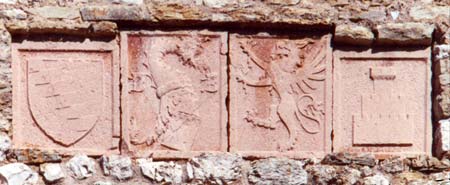
The current condition of the Tower remains adequate..1. I don’t believe the interior can be accessed without a ladder, since the old passage to it under the road has remained buried. On the west side of the Tower, the side that faces onto the Via Flaminia can be seen several coats-of-arms, among them those of Trevi, of Perugia, and of the Bishop Bardi (?) are in rather good condition.
A frazione of the township of Trevi, due north of Trevi itself, on the border of the township of Foligno. Matigge boasts of many old farmsteads, some of which are certainly the modern successors of Roman or even pre-Roman settlements.
The name, given in old documents as MATIDIA, is very interesting since such was the name of the beautiful granddaughter of the emperor Trajan and the mother-in‑law of the emperor Hadrian. In addition to her extraordinary beauty, as two portrait busts of her that have come down to us clearly bear witness, she was the object of a veritable and equally extraordinary veneration. In her honor Hadrian built a splendid temple, which in the 4th century was counted among the ten “basilicas” of the city of Rome. Some students of Antiquity have theorized that there might be a link between the ancient name of Matigge and the Roman noblewoman (see Bill Thayer’s diary, 9/11/98 in connection with his visit).
In the medieval period of the struggles between the townships, the area saw itself vested with a significant strategic importance as a bastion against Foligno, to which we owe Matigge’s most salient monument: The Tower.
The strategic importance of the place is confirmed by the fact that in former days, Matigge was a “terziere”: one of the three geographical entities that comprised the township of Trevi.
Among the monuments of Matigge the following should be noted the CHURCH OF S. NICOLÒ
A mountain frazione of Trevi township northwest of the town, it borders on the township of Foligno.
The antiquity of the settlement is attested by the placename harking back to a Roman landowner, as well as by numerous fragments of ancient artifacts scattered throughout the area.
The area is characterized by chestnut woods, although they are much less extensive than formerly: the growing of chestnuts has been abandoned.
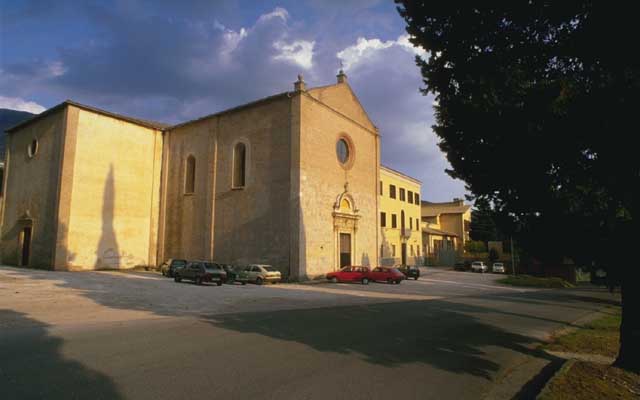
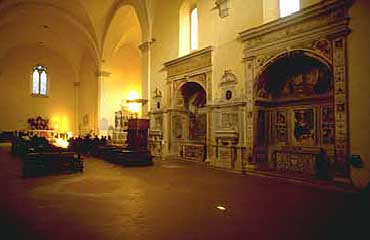
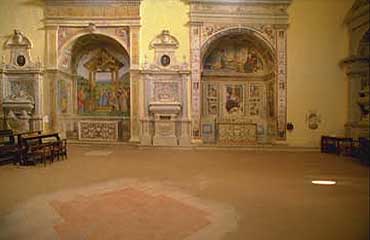
OUR LADY OF TEARS half way down the road to Borgo is an imposing Renaissance temple built on the site where a Madonna painting shed blood-stained tears.
The elegant portal (1495 ) is by Giovanni di Giampetro da Venezia. Inside are to be found frescoed altars by Spagna (1520) and Perugino (1521),also the Valenti family tombs.
For visits apply to the adjacent Istituto mons. Bonilli.
1-25 August, the main square is dedicated to numerous events in the evenings: music, recitals, plays, shows, folklore and gastronomy TREVI IN AUTUMN Echoes of the past in OCTOBER First Sunday: PALIO DEI TERZIERI or 3 team relay Cart Race preceded by a pageant parade Third Sunday: BLACK CELERY MARKET with A Sausage and Celery Festival. Exclusive to Trevi and grown only locally, the Black Celery is a variety of the more common type with a stronger but less pungent taste. Fourth Sunday: Scenes of Medieval Life and Times with roast chestnuts and other traditional food specialities served in the main square. Throughout the month, characteristic taverns re- open and the local restaurants serve seasonal dishes of by-gone times.
.*As mapped by the Touring Club Italiano (TCI) and the Automobile Club d’Italia (ACI) and as shown on highway signs, the name isS.M.di Pietrarossa, but in the Istituto Geografico Militare (IGM) map, which is supposed to provide the official nomenclature, the name is spelledPietra Rossa.
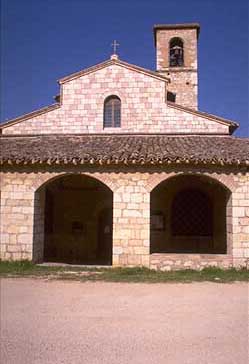
We have here a very interesting Romanesque church with three naves and an exterior portico on three sides. Both the interior walls and those under the portico are completely covered with frescoes.
The name of the church Pietrarossa: “Red Stone” derives from a large reddish stone inset in the second pilaster on the right-hand side of the central nave; it it is pierced by a central hole from which water probably once flowed. A very old tradition, maybe of pagan origin, claimed that this water had the miraculous power of curing infertility.
We learn that from time immemorial on St. John’s night (June 24) an increase in the water levels of wells in the area was noted, and until the late 16th century the women of Trevi used to come here in pilgrimage that night and the night of the feast of St. Ambrose. Gregory XIII, who had been a canon in Trevi and was well aware of the custom, among the first acts of his papacy forbade such manifestations; they surely related to customs and beliefs harking back to paganism. Similar midsummer night pilgrimages and baths are documented in various parts of central Europe.
The very numerous images of the Madonna that adorn the walls are only a few of those that could still be seen here as late as the mid-19c; in both number and quality they still elicit our admiration. The dates read on them, as well as critical analysis, place them in the 14th century. Among the names of painters that recur, those of Bartolomeo da Miranda and Valerio da Gualdo. Against the first pilaster on the right we can admire an elegant little marble altar attributed to Rocco da Vicenza, who worked here in the early 1500’s and left one of his best works in the church of Sant’ Emiliano.
Within the walls of the city and evenly scattered throughout the territory of the township a total of nearly thirty Romanesque churches can be counted. Not all of them are in a good state of preservation: some are reduced to scant ruins, and others to vestiges reused in later buildings. Together, however, they bear striking witness to art and faith, and constitute an extraordinary museum of our land. Every one of the buildings among them that retains elements reused from previous structures is a precious archaeological and epigraphical witness; and some are essential in reconstructing the ancient road network, both Roman and medieval.