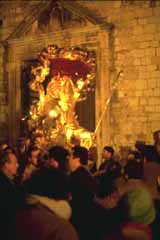
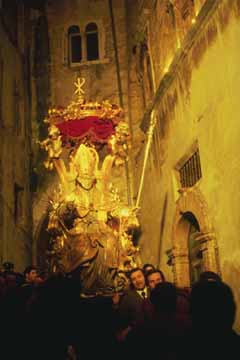
This is the oldest and longest -standing procession in Umbria, dating back to the Middle Ages. From time immemorial on the evening of 27th JANUARY at 6.30pm, the procession winds its way along the torch-lit streets, the statue of the Patron Saint Emiliano preceded by ‘cerei’ or floats prepared and organised by the local businesses and workshops (once the local guilds and artisans.
The procession route has remained unchanged since 1264.
In the original circuit of Roman walls, three gates can be identified. One, in the Via del Fiscale, has been unused since time immemorial and is perfectly intact; another, the Arco del Mostaccio, was modified during the rebuildings of the thirteenth century; and traces of the third can be made out at the end of the Via dell’Orticaro toward the Via S. Francesco. Any fourth gate that might once have existed would have been drowned in the buildings on the north side of town, across from the church of S. Francesco.
The
Porta Nova
, from the inside
In the early twentieth century, when the walls facing onto the Piazza Garibaldi were pulled down, so were the nineteenth-century
Porta Pia
and the Porta del Lago.
Today there remain six gates: the Porta del Cieco or Blind Man’s Gate; the Porta della Strada Nuova or New Road Gate (1857), the porta Nova or New Gate, the Porta di S. Fabiano, the Porta del Bruscito and the Porta dei Cancelli or Wicket Gate.
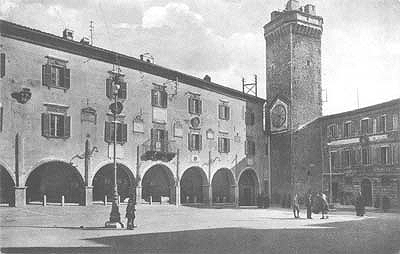
The focal point of town life, the Square is used for various activities and cultural events. Here there is the 13th century Town Hall, modified several times; the arcade was added in the 15th C. The windows and inscriptions on the lintels date back to the early 1500s and the balcony was added in the 17thC.
The CIVIC TOWER (13thC.) was lowered and rebuilt the following century. It is the symbol of the ancient commune In fact the town’s coat of arms bears a three-tiered tower.
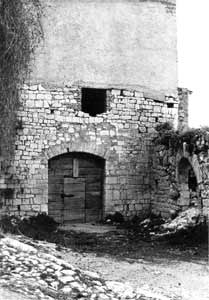
The old gate, which had been abandoned for centuries because it was somewhat inconveniently sited, and as a result had wound up giving onto a cliff, was replaced by a suitably fortified i
mpressive new gate
a few yards away.
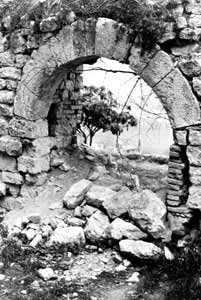
It had been blocked up for ages with dry set masonry that itself had in turn caved in. The gate stood for ages in the condition seen in this photograph: every once in a while part of it would crumble off, clearly foreshadowing its inevitable collapse.
As soon as it collapsed, all its stones vanished
Remains of the old gate (Photo: 1975)
Trevi , Via S. Fabiano. Remains of the façade of the church of S. Fabiano. On the right, the old gate providing access to the fortified town of Trevi (Photo: 1975)
The gate had survived the church by almost a century.
On a mere whim, according to the fashion of the day, the church was destroyed for the sole purpose of recycling the stone to rebuild the church of S. Croce.
The very handsome door was disassembled and now serves as the entrance to the sacristy of S. Croce.
TREVI town centre is literally surrounded by undulating green olive groves reaching right up to its medieval walls. THE PASSEGGIATA is a magnificent 800m tree-lined road with spectacular views onto the valley below Cart tracks lead up to an altitude of 1000m in 10 minutes from where it is possible to continue for the peaks of Monte Brunette (1425m) and Monte Serano (1429m) with no great diffulty. Among the various guides and itineries on the market, the Pro Trevi suggests ” TREVI -Itineries in the hills and mountains” as for each itinery there is a detailed description of the countryside, ground composition, flora and fauna, with historical notes.
The museum is situated in the evocative area of the ex Saint Francis convent, which also houses the homonymous Church and the Art Collection. It is the first public museum in Italy and in Europe dedicated to oil and olive tree and is divided into four sections:
Botany
Getting to know oil and the olive tree
Oil as a symbol of peace
Oil history
The exhibition offers visitors different approaches. Information on the olive tree in history, botany and agronomy is provided by boards with data of Centro Nazionale delle ricerche (National Research Centre). Ro Marcerano’s cartoons are intended for children. Interactive devices give details about the pressing techniques, while documentary films show the “fiscoli” (or “buscoli”, coconut fibre filter discs) are handcrafted, the different cultivation phases and the removal of the diseased parts of a plant with a technique called “slupatura”.
Sophisticated equipment enables visitors to taste and learn how to feel the difference between the oil varieties, while a section is designed for chemical tests to quantify the oil acidity. And if you want to enhance the quality of your cuisine with new and tasty dishes you can download and print chef Angelo Paracucchi’s tasty recipes of gastronomic specialties prepared with olives and olive oil.
The museum also has an important private collection of archaeological finds – kindly loaned by Jean-Pierre and Fiorella Cottier – connected with the symbolic value of the olive tree and the use of oil: a remarkable collection of oil lamps some of which are Phoenician and date back to the 8th century B.C. Equally interesting is the collection of unguentary vases and ancient objects decorated with oil-related motifs. A big three-screw press, built at the turn of the 18th century, and a grindstone mark the end of the tour.
The representation of the olive tree as a feature of the landscape in wider scenes or as an isolated element is quite common in Greek and Roman art both in pictorial works and in sculpture or in toreutics and in vase painting, where the olive tree is often the symbol of the landascape against which the scene is set.
More frequently the representation of the olive branch seems to acquire a purely decorative value, even if one cannot exclude the symbolic value of the landscape and the use of the container on which it is represented. This type of representation appears in the Attic art of the 5th century B.C. and later also in the pottery production made in Greek colonies and areas in close contact and trade relations with Greece, like for instance Etruria. A typical example is a kind of cup, the “glaukes” (from “glaux”, owl) decorated on both sides by an owl (Athena’s symbol) flanked by two olive branches, maybe a symbol of the introduction of the olive tree into Attica by Athena.
Both literary sources and archaeological finds report us customs concerning the treatment of one’s personal appearance. The use of cosmetics expresses the need to communicate one’s individuality through targeted messages intended for a precise purpose. The use of cosmetics and fragrant substances is at first linked to magic-religious functions and afterwards it becomes a decorative phenomenon of the person. The study of archaeological finds, from artistic production to material culture, allows us to reconstruct the cosmetic habits of ancient times.
Most of the fragrant essences came from the East and were traded ever since the 8th– 7th century B.C. The several containers of ointments of Greek or oriental production, also in the Magna Graecia and Etruscan or Italic areas, show a thriving trade and a widespread use of such products at least in the affluent classes.
Olive oil formed the fat base for the various fragrant components; the “omphacium” in particular, obtained from big green olives, was the most popular item (Plinius, Naturalis Historia, XIII, 2, 3).
In the Roman world the use of cosmetics was all pervading and several literary sources tell us about it. For example Ovid is the author of a manual on make-up, whereas other authors (Martial, Seneca, Horatio etc) describe aspects of everyday life linked to body care.
Several archaeological finds bear witness to the use of make-up and perfumes: baked clay, unguentary vases, glass, hard stones, oil containers, mortars for the preparation of cosmetic pastes, spatulas to take small quantities of balm from a container or to mix products.
Cosmetics was not limited to women. For example athletes also used perfumed oils. Typical of the male world and linked to personal care was the “strigil”, an instrument for cleansing after doing exercises in the gymnasium. It was common in the Greek and Etruscan world already in the 5th-4th century B.C..
The use of oil for lighting is strictly linked to a particular tool: the oil lamp, which was the most common mean of lighting in ancient times. In such a container people burnt the oil through a wick. The invention of oil lamps dates back to very ancient times. Its use, besides the lighting of houses, temples, public and private buildings, acquired particular importance in burial rites, as a present that accompanied the dead, an exorcism and symbol of rebirth. The most common material was clay but there were also several bronze, precious metal, glass or stone lamps.
The shape underwent great changes overt time. From a morphological point of view we can identify three parts: the body, the beak and the handle. The most ancient shapes were open, whereas in Greek and Roman times they were closed. In the closed shapes, in the centre of the disc that constitutes the upper part of the tank, there is a hole for pouring in the oil from neck pots, like the “buttus”, and another smaller hole in order to make the draught better.
THE CHURCH AND CONVENT OF ST. FRANCIS. The original Romanesque church was completely rebuilt in the 14thC. The crucifix is of the early 1300s and the organ dates back to 1509. The convent, founded by St. Francis himself, was eventually completely rebuilt. In the cloisters the frescoes are by Gagliardi (1614) The premises of the ex-convent now house.
THE ST. FRANCIS ART COLLECTION
with paintings from the 14th – 17th centuries and Roman remains. Particularly noteworthy are: a set of three panels and a multi-panelled painting attributed to the Foligno school, an altar piece, St. Catherine and St. Cecilia by Spagna and an Assumption by Orbetto.
THE FLASH ART MUSEUM (plan no.26 C2) This is housed in one of the most prestigious Residences in Trevi, namely the Lucarini residence opposite the church of St. Emiliano. This contemporary Art Museum hosts regular international exhibitions. (opening times: 10-13 and 15-18.30. Closed Mondays and Tuesdays (Translated by Sheila Rylands 1998)