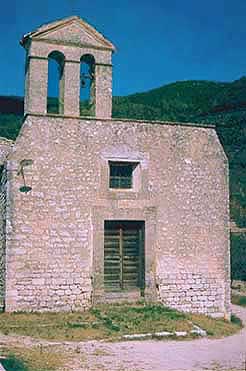
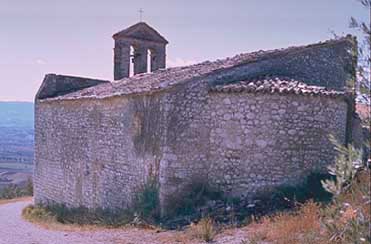
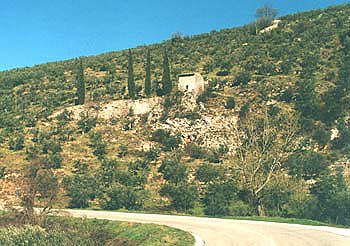
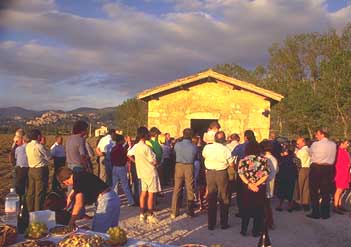
The church of S MARIA di PIETRAROSSA is to be found in the centre of a much neglected ARCHEOLOGICAL SITE perhaps originally part of a spa or thermal springs. Here, there are Roman remains and numerous 15thC. paintings.
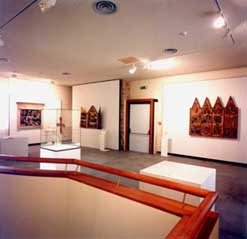
It was opened in October 1996 in the south-west wing of the former Saint Francis Convent and it is named after it.
The successful renovation of the premises was supervised by architect Giuseppe Bettini who managed to turn the extant spaces into a functional exhibition area.
Particular attention is to be given to the architectural structures and decorations of the Cloister and of Saint Francis Church which are an integral part, an exceptional “container” of the exhibition works and nicely complete them.
The collection includes pictures and sculptures, archaeological finds, drawings and relics from the former municipal gallery and the historical archives which are being rearranged.
Guided tour
The northern wall of the entrance room is occupied by a big fresco of the late 14
th
century, removed in the early fifties from a wall of the former church of Santa Croce monastery. It represents the
Crucifixion, the Virgin Mary on the throne with Child and Annunciation
.
The rooms on the ground floor contain different objects which are being rearranged to form the Town and Territory Museum.
Two-faced Janus, head of the 2nd century.
Saint Francis from Assisi, little sculpture of Tuscan school, 16th century, coming from the church of the Madonna delle Lagrime.
Shelves in travertine, 9th century.
Drawings of the Town Hall and of the Ball Game.
Papal Bull with which Pio VI granted Trevi city status in 1784.
Ten votive Tablets, of the early 16th century, painted with different techniques, coming from the church of the Madonna delle Lagrime.
“Fondi Oro” room on the second floor
Altar cross, tempera on board, by an Umbrian master. Reminiscent of the Master of Cesi, about 1310, in bad condition.
Adoration of the Magi, by a Flemish painter of late 15th century, coming from S. Domenico convent. The characters look very old.
Triptych
with scenes of Christ’s life. Work of the early 15
century ascribed to Giovanni di Corraduccio. It comes from the church of S. Croce in Piaggia. It bears the clients’ names: Cicco Urighi and Jacobuccio di Mattia.
Polyptych
, similar to the Triptych, about 1430, originally in Saint Francis church. The central part is missing and therefore originally it had five panels.
pannelli.
Portable cross with the Madonna and Saint John on one side and Saint Francis from Assisi and San Ludovico da Tolosa on the other.
Deposition
, by a Tuscan-Roman painter of 1520-30. It comes from the church of the
Madonna delle Lagrime.
On the ground floor you can admire the following works:
Emmaus supper, by a local painter from Umbria or the Marches of the end of the 16th century, coming from the convent of the Capuchins.
Virgin Mary with Child, S. Maria Maddalena and S. Caterina: painting of the early 17th century, ascribed to a painter from Umbria or the Marches.
People in prayer, lower part of an altar-piece commissioned by Muzio Petroni for the “Compagnia del Rosario” in the Sant’Emiliano’s Church. Maybe the author is Ascensidonio Spacca, called ”il fantino”; the work dates back to the early 17th century.
Assumption of the Virgin and Saints
, painting by Tommaso Maurizi and dated 1602.
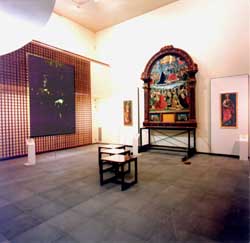
In the centre of the wall at the end of the room: Coronation of the Virgin and Saints, splendid altar-piece by Giovanni di Pietro, called “lo Spagna”. S. Martino who shares his cloak with a poor man and Saint Francis stigmas are portrayed in the predella. The central part, missing since the 19th century, was found by Federico Zeri in 1969 in Tucson Museum, Arizona. The work was originally placed on the high altar of San Martino Church.
Two other paintings by lo Spagna, portraying Saint Cecily and Saint Catherine, are on either side of the “coronation”. They come from the church of the Madonna delle Lagrime,, where they adorned S. Alfonso chapel, the second on the left from the entrance.
by Vincenzo Turchi called l’Orbetto. It is a big, wonderful painting, recently restored, a “timeless picture”. It was painted in Rome and brought to Trevi in about 1640.
Miracle of S. Vincenzo Ferrer, probably painted in 1729 on the occasion of the building of the new altar dedicated to the Saint in San Domenico Church. The painting is ascribed to a painter of the “Nasini circle”.
The incredulity of San Tommaso, first decade of the 17th century, by a Roman painter. It comes from the former church of the saints Tommaso and Lazzaro, on the via Flaminia.
San Francesco di Paola, also by a Roman painter of the second half of the 18th century. Maybe it was originally in the Capuchins’ church.
Going out onto the open gallery overlooking the Cloister, you can enter Saint Francis Church.
Subject: KATHARINA FROM ALESSANDRIA
Author: CARL TIMNER
Born in Berlin in 1933. He was Guttuso’s assistant at the Fine Arts Academy in Hamburg.
Technique: Oil painting
Size: cm 160 x 203
Description: The picture is a parable against all kinds of fanaticism and against war. Behind Katharina’s figure you can see the historical figure of the Hellenistic philosopher Hypazia, who was killed by a little group of fanatics that tore her to pieces with some shells, while Saint Katharina is rent by a cogwheel and beheaded.
Provenance: Author’s donation on the occasion of the anthological exhibition “Opere” held in this museum from the 8th of June to the 6th of July 2003.
This little church stands on a very ancient path that connected Trevi to the great Roman road of the Via Flaminia toward Foligno: and it preserves for us, reused, parts of antique monuments that bear witness to the ancient road system.
The building is strictly oriented, thus putting its façade on the west. That façade is surmounted by an open belfry of the type known as a “campanile a vela”; all of it is in good condition after restorations conducted in 70’s.
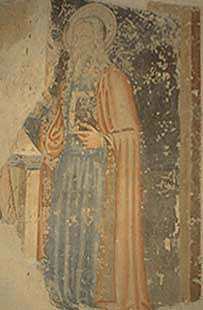
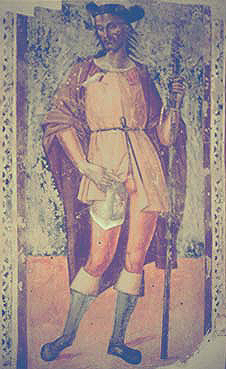
The interior boasts two early‑16c frescos, one depicting St. Andrew the church’s titular saint, the other St. Rocco.
This church, already cited in the Corpus Inscriptionum Latinarum (CIL) because two ancient inscriptions now in the S. Francesco Art Museum1 had been found in the interior, has recently given us two more classical inscriptions: they were discovered in 1970 when the building was restored
2
.
Trevi, Italy – Church of S. Andrea in Collecchio, ,
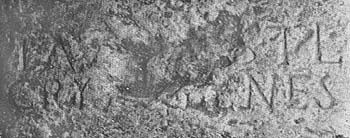
ancient inscription number 1
A slab of local limestone measuring 53 × 112 × 22 cm was at the time being used as part of the chancel step. It is now set up against the entrance wall. Its corners are somewhat damaged: the lower left corner is completely missing.
The inscription here reproduced is in two lines, 68 and 56 mm high respectively, and it only occupies the upper portion of the stone. An irregular 22 × 13 cm hollow has damaged both lines.
The following letters can be read::
T . A V / / / S . T . L C R Y / / / / E N E S
The first line might be interpreted: T(itus) AV(fidiu)S – or AV(gustu)S, or AV(reliu)S, or AV(soniu)S, or AV(ienu)S, – T(iti) L(ibertus), but no adequate suggestion has been made for the part missing in the second line. Before ENES the lower part of a letter can be made out: it might be a G or an S. The letters are well aligned and carefully carved, but have been partly damaged by weathering, to which they have obviously been exposed over a long time.
Although it is impossible to date this inscription from its content, the shape of the letters lets us tentatively assign it to the first centuries A.D.; the presence of the letter Y further betrays an inscription later than the republican era.
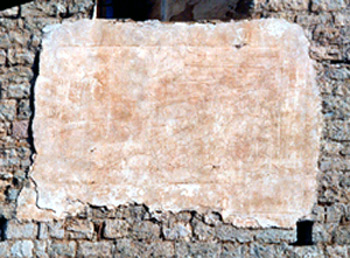
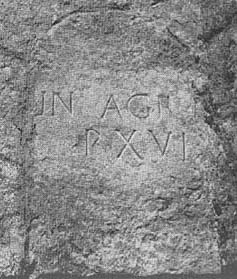
Another inscription, although carved in a stone reused in the left-hand corner of the façade, had remained unnoticed because a thin layer of plaster had filled in the letters. It was only by the particularly strong light of the sun at noon, grazing the stone, that some kind of sign was eventually made out. Today, a nearby pew, although convenient, hides the inscription somewhat.
ancient inscription number 2
The stone, seen in this photograph rotated 90° counterclockwise, measures 45 × 69 × 23.5 cm and its upper part is rounded. It reads:
I N A G R P X V I
The letters of the first line are 65 mm high; those of the second, 75 mm. The second line is shifted to the right, which might lead us to assume other letters beyond the AGR in the first line as it originally read, but the rounding of the upper portion must surely represent the original cutting of the stone.
From an epigraphic standpoint this inscription is of no interest since it repeats a formula extremely common in funerary inscriptions, indicating a grave area 16 feet deep.
These funerary inscriptions, together with the other two already found in this little church, mark the presence of a road already existing in Roman times (since it was along roads that they used to bury the dead) and thus bear witness to the antiquity of the road from Trevi to Foligno.
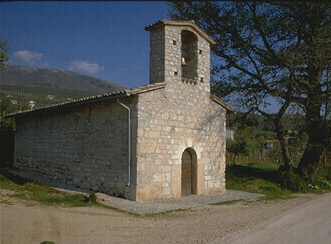
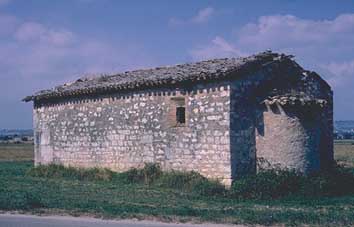
The building is very simple, repeating the typical local Romanesque formula of the little churches in the valley: a single nave, a pitched roof and a semicircular apse. There is no trace of a belfry.
Inside, two big round arches support the beams and create three spaces. The arches may have been built instead of trusses in order to simplify the roofing.
The walls are completely bare, except in the apse where a single fresco, much effaced, depicts the titular saint.
Like all the churches of the period it is strictly oriented, with its entrance on the west and its apse to the east.
It had been abandoned for several decades, but was recently restored and made usable again by its new owners.
No documents are known that might indicate the date when this church was built, but its dedication to St. Apollinarius, a saint particularly venerated by the Lombards, dates it originally to the 6th through the 8th centuries, when Spoleto was ruled by Lombard dukes (from 570 to 774).
In 1177 it is mentioned in a brief of Pope Alexander III, where along with one hundred other officiated churches, it was recognized as falling under the jurisdiction of the powerful Benedictine monastery of S. Pietro in Bovara.
It is mentioned another time in 1333 in a list of tithes collected.
Trevi historian Durastante Natalucci tells us that it was a church that cared for the souls of nine families of parishioners in 1404 and fourteen in 1432. He also tells us that in his day (the first half of the 18th century) it was provided with “a new painting of its saint” and that it was still a dependency of the monastery of Bovara even though the latter had lost its ancient splendor. In old documents the church is mentioned under the name of S. Apollinare di Porcaria because Porcaria was at the time the name of the stretch of land that has now taken its name from the castle of San Lorenzo, but we know that in the 18th century the church name was in use since the area immediately around it was called S. Apollinare.
Seen from the southeast, before restoration
The church was rebuilt from the foundations in the 12th century and has since been been reworked many times, especially its upper portion.
From: Father Aurelio Bonaca, Religione e beneficenza in Trevi (Umbria), notizie storiche, Trevi, 1935.
Halfway up the mountain that rises sharply from the hamlet of Pigge, stands the church of S. Arcangelo. It is very old, attested in briefs of Alexander III (1177), Celestine III (1193), Innocent III (1198) and Honorius III (1217) in favor of the abbey of S. Pietro in Bovara. In those briefs, the church of S. Arcangelo is listed among those that belonged to the abbey; it is older than those dates, though.
It was a modest little church for the use of the few inhabitants scattered throughout the area; it may originally have been the home of one of the many hermits that lived in our mountains, all the way to those above Pissignano. Among those hermits I am happy to record Blessed Ventura, born in Pissignano in 1250, who died in July 1310, whose body was conveyed with great honor and buried in the church of S. Francesco, where it is still venerated.
At some uncertain time the church of S. Arcangelo fu ingrandita e vi fu aggiunta la parte verso monte, al di là dell’arco che si trova verso la metà della chiesa.
Quando nel 1421 Corrado Trinci invase e distrusse l’abbazia e ne discacciò i monaci, le chiese dipendenti da Bovara rimasero abbandonate e, come ho detto altrove, in parte furono occupate dal Vescovo di Spoleto; tra queste vi fu anche la chiesa di S. Arcangelo, che fu data in custodia a un priore e a due canonici rurali. I due canonicati esistevano ancora nel 1745, when Durastante Natalucci was completing his Storia di Trevi (D. Natalucci, Historia … di Trevi, p53) Essi venivano conferiti dalla Dataria Apostolica e i beneficiati non avevano l’obbligo della residenza.
Nel 1544 era unita, per la cura d’anime, alle chiese di S. Maria, poco lontana, e a quella di S. Giovanni di Pigge. Siccome però queste tre chiese erano in cattivo stato, la cura d’anime nel 1572 fu trasportata nella chiesa di S. Bernardino e rimase ufficiata soltanto la chiesa di S. Arcangelo; tutto questo avvenne per decisione della Balìa di Pigge, che fece obbligo al parroco di andarvi a celebrar messa. Ma la Congregazione del Concilio nel 1686 e nel 1695 sentenziò che la chiesa di S. Arcangelo era la sola e vera parrocchiale, e non quella di S. Bernardino, che era jus patronatus del popolo.
Ciò non impedì che la chiesa di S. Arcangelo restasse abbandonata, tanto che nel 1675 era senza porta ed invasa da erbe, da rovi e da piante diverse, e serviva da rifugio ai pastori durante i temporali. [Il completo abbandono in cui giaceva la chiesa nel 1675 sembra contrastare con i fatti narrati in seguito; proprio in quei tempi, a 30 anni dall’apparizione e in pieno fervore di opere – strade, suppellettili, campanile, fontane – la chiesa avrebbe dovuto essere ben curata.]
Secondo una pia narrazione, nel 1645 una pastorella, che aveva smarrito un sacco, vi si andò a nascondere per timore di ricevere delle percosse dalla mamma. La pastorella si mise a pregare la Madonna, e la Madonna le apparve, le parlò, la consolò. Da quel giorno, sparsasi la notizia, fu un grande accorrere di persone, e molti furono i miracoli fatti allora dalla Vergine (Jacobilli, Cronica del monastero di Sassovivo, Foligno, Alterij, 1653, p230) e le offerte portate dai fedeli. Il concorso era continuo, ma si verificava specialmente nelle feste di Pentecoste per il fatto che speciali indulgenze si potevano lucrare in quei giorni. Il Comune nel 1647 fece ingrandire ed aggiustare la strada per accedervi, tanto grande era l’affluire delle persone.
In 1656 the Comune of Trevi prese l’iniziativa di una grande processione votiva per ottenere dalla Vergine che la nostra regione fosse liberata dalla peste, che allora infieriva di tanto in tanto. L’appello del Capoluogo fu accolto dalle frazioni di Trevi e anche da alcuni comuni vicini, e tutti fecero voto di andare ogni anno in processione a visitare the Madonna di S.Arcangelo, al fine di ottenere per sempre la liberazione di tanto terribile flagello.
In 1646 the City Council of Trevi had appointed four deputies to receive, with the Vicario Foraneo, donations to restore the church, but the Balìa di Pigge fece valere i propri diritti e perciò ogni cura e ogni incarico rimasero a speciali santesi e al parroco, sotto la sorveglianza del vescovo di Spoleto.
I restauri cominciarono subito, la chiesa fu abbellita e arricchita, fu costruita la sagrestia, che fu provvista di un bel credenzone [purtroppo trafugato intorno al 1980 !], fu elevato il campanile, nel quale furono collocate tre campane, una delle quali era stata donata dal Comune nel 1647; nel 1692 e nel 1702 furono costruite, per comodo dei fedeli, le due fontane ancora esistenti poco lontano dalla chiesa [attualmente se ne vede una, e secca!].
In breve tempo la chiesa fu dotata di beni, mercé le offerte dei fedeli, e vi furono eletti cappellani, eletti dal Vescovo, i quali si alternavano nell’ufficiatura della chiesa.
The church stands on a pleasant hill at 550 m above sea level with a splendid view onto the valley, and can be reached from Bovara by a little paved road.
It is first mentioned in papal briefs in 1177 as a dependency of the Abbey of S. Pietro in Bovara, but betrays its Lombard origin by its dedication to St. Michael the Archangel; it must therefore have been founded several centuries before the earliest documentary evidence.
Enlarged and reworked over the course of the centuries, it has nonetheless retained from the original Romanesque building part of the façade, its modest doorway and the north wall.
The former convent of S. Arcangelo, from the north.
The main altar includes a fresco of the Umbrian school depicting the Madonna and Child, attributed to Bartolomeo da Miranda..1
In 1421, when Corrado Trinci invaded the Abbey of S. Pietro, the church of Sant’Arcangelo, like many other churches dependent on that Abbey, was abandoned
The lower portion of the belfry and the ancient façade of the Romanesque church.
According to a pious legend the Virgin appeared here in 1646 to a shepherdess. Since then it became a place of pilgrimage of such importance that the municipality had to intervene to widen the road.
In 1656 a large votive procession was held here to free Trevi from the plague.
The belfry and the adjoining convent date from that time.
A feast is celebrated here at Pentecost; processions from Trevi and all her villages used to wend their way up to the church on the three festal days, and up until just after World War II the mountain villages still used to make their procession on Pentecost Monday.
“Amici di S. Arcangelo”, the association of Friends of S. Arcangelo, whose worthy aim was to restore the large rooms of the convent and to highlight the entire compound, was dissolved after many years of generous and laudable volunteer work.
Over the door, right up against the window, an old sundial can be seen, without its gnomon, but otherwise complete with its hour lines and frame. Restoration work after the 1997 earthquake led to its rediscovery by bringing back to light the stone of the façade that had been covered by a layer of stucco; paradoxically the dial is now at greater risk because its edges, no longer protected by that stucco, allow rainwater to seep in.
Its placement on the west-facing front of the church, where only afternoon hours can be read, suggests that there is or was another sundial on the east or south side of the building from which the morning hours were given. (2005, unpublished hypothesis) 054
We have here a former parish church, as is shown by the placename La Cura that it gave to the surrounding area. It is now almost completely smothered in the successive extensions of the cemetery; yet it dominates the rocky spur that overhangs the village and seen from the valley below, it is still quite beautiful.
Like many churches of the same period, it is strictly oriented: its apse points due east.
The façade was ostentatiously reworked in 1630 and 1769.
Façade
The south wall and apse before the cemetery was enlarged.
.
The interior is provided with three large polycentric arches that support the roof.
The walls preserve remains of mediocre frescoes of the late 16th century: the Adoration of the Magi bears the date 1575. (Nessi).
In 1571 S. Bernardino became the parish church when the older churches of S. Maria, S.Michele Arcangelo, S. Giovanni and S. Marco were merged into a single parish.
Fortress-like in its impassable situation on the slopes of the mountain behind Trevi, the Church of S. Caterina is reduced to not much more than a hut.
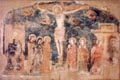
The site is very picturesque and the little clearing in front of the building gives onto an oustanding panoramic view. The church’s most interesting element is the apsidal wall, entirely covered by a fresco measuring 3.00 by 2.70 meters: a highly dramatic representation of the Crucifixion, with life-size figures
The church was probably abandoned because it was somewhat hard to get to, and because two hundred meters from it there was the much larger church, with daily services, of the splendid convent of the Capuchins before the cemetery absorbed it.
The people of Trevi, from very ancient times, have had a living devotion to St Catherine, attested by a number of painted works adorning both sacred and secular buildings in the town and its territory, and this little church, dedicated to the Alexandrian martyr, gave its name to the place, which from time immemorial has been known as the “costa di S.Caterina”, St. Catherine’s ridge. But old-timers remember S.Caterina also with reference to olive growing, since it was on her feast day, November 25th, that the harvest of the precious fruit would begin, after the people attended Mass in the little church, which is completely surrounded by olive groves. In the late 19th century the church of S.Caterina was almost completely demolished in order that its stone might be reused to build the east wing of the hospital; it was at that time that the church was reduced to its current condition. Guided though they were by the most practical and utiliarian criteria – nothing new under the sun! – the administrators of the time chose at least to spare the large fresco on the back wall. Today in fact there remain only that wall and a very small opening across from it, now bricked up.
In 1942 Don Aurelio Bonaca, the fondly remembered priest of Trevi, called attention to this church in a little publication in which he lamented the fact that this magnificent fresco adorned what by now was merely a hut used as a staging point by the women who picked olives. Fr. Bonaca’s appeal was sedulously ignored by the authorities of the time because it was during the war, and then by their successors since the war was over and the agenda was reconstruction.
In the 1970’s the fresco was examined by Silvestro Nessi who pushed its dates back by a century to the early 1300’s, and attributed it to the Master of S. Chiara di Montefalco (Spoletium n. 21, 1976), based on very evident similarities between the two paintings. But even then, busy with great works, no one took any interest. Nessi also reported the curious fact that in 1632 the fresco had been studied by the Capuchin Fr. Zaccaria Boverio, who from the habit of St. Francis depicted at the foot of the cross, had extracted information that helped him reconstruct the evolution of Franciscan dress over the centuries
The painting then received the attentions of the most eminent scholars and the competent public authorities.
In the summer of 2000 Vittorio Paris, the Trevi painter of the naive school, reported the information (further disseminated by the press) that the door had been forced open, probably by homeless people, who had driven nails into the painting to use them to hang their clothes.


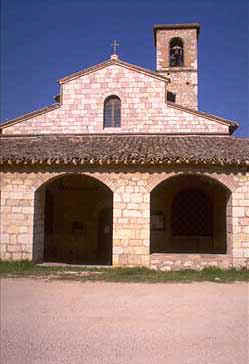

 S.Apollinare