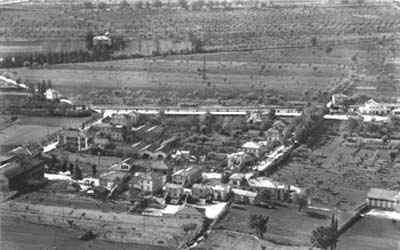
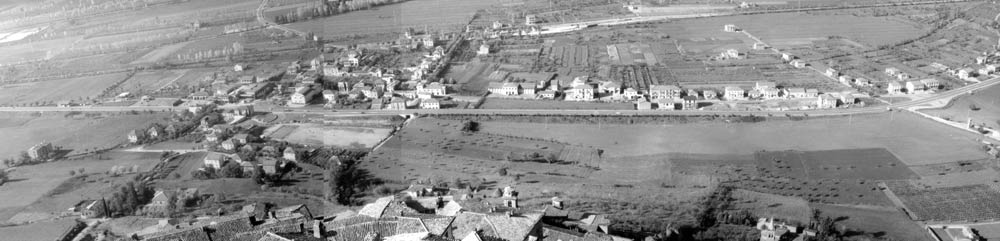
Nuova frazione del comune sviluppatasi tra la Flaminia e la ferrovia nel corso del 20° secolo.
Già nel 1178 è documentato un ospizio annesso alla chiesetta romanica di Sant’Egidio, costruita con materiali di spoglio di edifici di epoca romana.L’ospizio, per il ricovero e l’assistenza ai viandanti, fu affiancato da una locanda più volte ricordata negli atti comunali, che stabilivano regole e tariffe.
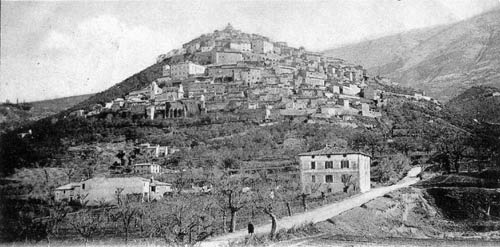
Trevi – Panorama. In primo piano gli edifici esistenti a Borgo alla fine dell’800
Nel 1496 vi pernottò il Cardinale di Santacroce, che si recava ad incontrare l’imperatore.
Proprio all’incrocio della vecchia Flaminia con la strada Trevi-Montefalco (ora disgraziatamente messa fuori uso) esiste un bell’edificio del XVII secolo, il più antico dopo la chiesa e l’ospedale già ricordati.
L’abitato ha cominciato a svilupparsi dopo la costruzione della ferrovia alla fine dell’Ottocento, ma è nell’ultimo dopoguerra che che si è registrata una vera e propria esplosione edilizia e demografica.
Nei primi anni ’70 fu costruita una nuova chiesa (consacrata il 22/10/1973 ) risultando ormai assolutamente insufficiente la chiesa di S.Egidio.
Località del territorio della frazione di Matigge, sita a nord-nordovest di Trevi, nel fondovalle, sul confine con il comune di Foligno.
Il nome le deriva dal salto delle acque del Clitunno a causa di uno sbarramento artificiale nel punto ove ha origine il “Canale dei Molini di Montefalco” che va ad alimentare l’opificio posto in località Torre di Montefalco
Nella mappa il tag “Fiume Citunno” è posizionato erroneamente sul Torrente Marroggia Il Fiume Clitunno è il canale parallelo, immediatamente a est, che attraversa l’abitato di casco dell’Acqua
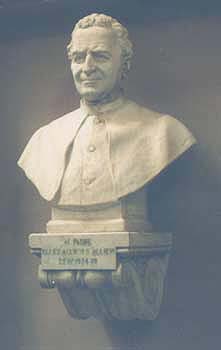
e allievi nel 1934, anno della canonizzazione dell’illustre Maestro. La dedica recita:
AL PADRE GLI EX ALLIEVI E ALLIEVI 22 IV 1934 XII
Il busto fu degnamente collocato nel chiostro del convento di S. Francesco, allora sede del collegio, in alto sulla parete est, sopra al porticato. Partiti i Salesiani nel 1963, l’edificio venne gestito direttamente dal Comune, che vi sistemò la nuova Scuola Media e successivamente, nel 1997, anche il museo. Ritenendo che il busto fosse in contrasto con il resto dell’edificio, fu rimosso dalla sua sede e messo al suolo, togliendo così la testimonianza di 70 anni di benemerita operosità dei salesiani a Trevi. Con la stessa leggerezza, si intitolò la Scuola Media, ora Istituto Comprensivo, a Tommaso Valenti invece che mantenere il nome di Lucarini, che aveva fondato e dotato il collegio.
L’Unione ex Allievi di Trevi richiese ed ottenne il busto dal sindaco e finalmente, passato il terremoto e il post-terremoto, nell’ottobre del 2002, fu collocato nell’attuale sede, d’accodo con il parroco Don Angelo Nizzi, che intende trasferire in questa chiesa anche alte memorie salesiane locali.
Al di là del sentimento devozionale, don Bosco sta a ricordare l’opera dei Salesiani a Trevi. Questa famiglia religiosa impresse un notevole impulso al Collegio, divenuto sede di scuola media parificata che giunse ad accogliere circa 150 convittori, più gli “esterni”. La scuola media a Trevi permise a più generazioni di trevani di poter accedere ad un grado di istruzione superiore, in quanto, mancando fino agli anni ’50 collegamenti efficienti con Foligno e Spoleto, occorreva trasferirsi in città in tenera età e non tutti ne avevano la possibilità.
Parallelamente molti ragazzi delle località più o meno vicine, in particolare da Spoleto, frequentarono la scuola media in questo Collegio, confermando l’altissimo prestigio a cui era assurta questa benemerita istituzione trevana.
Casco dell’Acqua is a little knot of houses in the frazione of Matigge, north-northwest of Trevi, at the bottom of the valley, bordering on the township of Foligno.
The name, meaning “Falling of the Water”, derives not from a waterfall properly speaking, but from a drop in the waters of the Clitunno river due to a manmade weir: at which point the “Canale dei Molini di Montefalco” takes its rise; this Montefalco Mill Channel then feeds the industrial plant at Torre di Montefalco.
On the map the tag “Fiume Citunno” is mistakenly placed on Marroggia Creek; the Clitunno River is in fact the parallel channel immediately east of the tag that goes on to traverse Casco dell’Acqua.
.*As mapped by the Touring Club Italiano (TCI) and the Automobile Club d’Italia (ACI) and as shown on highway signs, the name isS.M.di Pietrarossa, but in the Istituto Geografico Militare (IGM) map, which is supposed to provide the official nomenclature, the name is spelledPietra Rossa.
A mountain frazione of Trevi township northwest of the town, it borders on the township of Foligno.
The antiquity of the settlement is attested by the placename harking back to a Roman landowner, as well as by numerous fragments of ancient artifacts scattered throughout the area.
The area is characterized by chestnut woods, although they are much less extensive than formerly: the growing of chestnuts has been abandoned.
A frazione of the township of Trevi, due north of Trevi itself, on the border of the township of Foligno. Matigge boasts of many old farmsteads, some of which are certainly the modern successors of Roman or even pre-Roman settlements.
The name, given in old documents as MATIDIA, is very interesting since such was the name of the beautiful granddaughter of the emperor Trajan and the mother-in‑law of the emperor Hadrian. In addition to her extraordinary beauty, as two portrait busts of her that have come down to us clearly bear witness, she was the object of a veritable and equally extraordinary veneration. In her honor Hadrian built a splendid temple, which in the 4th century was counted among the ten “basilicas” of the city of Rome. Some students of Antiquity have theorized that there might be a link between the ancient name of Matigge and the Roman noblewoman (see Bill Thayer’s diary, 9/11/98 in connection with his visit).
In the medieval period of the struggles between the townships, the area saw itself vested with a significant strategic importance as a bastion against Foligno, to which we owe Matigge’s most salient monument: The Tower.
The strategic importance of the place is confirmed by the fact that in former days, Matigge was a “terziere”: one of the three geographical entities that comprised the township of Trevi.
Among the monuments of Matigge the following should be noted the CHURCH OF S. NICOLÒ
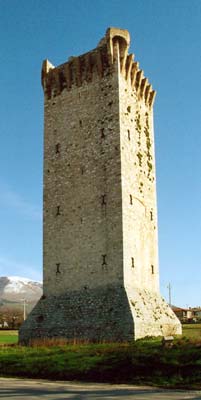
A witness to the restless and bloody struggles among the townships during the Middle Ages, the tower rises imposingly by the side of the Via Flaminia: a powerful instrument of defense, but also a striking demonstration of the power of the comune of Trevi.
The many commercial and industrial buildings that have recently sprung up around it have sapped much of the menacing grandeur that it had up to the middle of last century.
Old folk still remember truculent tales of brigands who conducted their nefarious enterprises in this place. The solitude of the place and the disquieting, enigmatic lack of any door by which the interior might be accessed (no one has ever seriously looked for the underground entrance, and if anyone found something during the construction of those new buildings, they certainly never spread the word about) gave rise to many fearful tales and continue to feed them today.
The tower was recently consolidated after the 1997 earthquake.
The tower seen from the NW- photo 2/24/2004
n.670-16c
The events that led to its construction and the importance it had in past centuries are well described by the following article, excerpted from:
To the east of the Via Flaminia, the ancient Roman road, about halfway between Foligno and Trevi, rises this interesting monument, arresting the attention of the traveller, and keeping alive for us and for others a legend of fearful events, of horrendous assaults and murders committed nearby.
We find many interesting memories of the tower in our own archives, the Archivio delle Tre Chiavi. On September 28, 1392 a certain Angelo del Medico proposed to the City Council of Trevi that in order to defend against malefactors who lurked in the environs day and night, committing all sorts of crimes, a huge fosse or ditch be dug on the lower slopes of the mountain of Matigge with a well-constructed tower, and that three good men vested with full legal powers — tres bonos et legales homines — be put in charge of the work. And in fact on December 29th of that year Manente di Petruccio, Ser Angelo del Medico and Ser Andrea di Ser Nuccino were duly appointed.
They did not, however, set to work right away, and the Council had to insist that they be requested to do so. To facilitate the work Del Medico was given the right, on November 1, 1393, to exact a sort of forced loan from the inhabitants of Matigge (imponere prestantiam) to be paid back to them by discounts on their regular taxes in the future (in successivis dativis).
So the required equipment and material were gathered together, but by the end of 1394 the work had not yet started; and on December 18th of that year the Council pressed the Commission once again to think seriously about building the Tower.
Finally, on January 10, 1395 the contract was drawn up with the mason Gregorio da Cerreto, who had also built the Tower in neighboring Fabbri, requiring of him various terms and conditions, and imposing a fine of one hundred pounds in case of default. The work, however, proceeded by fits and starts, and maybe none too well, since on September 13, 1395 the Council recommended once again that the contractor be pressed and that the work be of high quality and beautiful and of the measurements that had been agreed upon.
Shorly thereafter the Tower was finished and a guard was assigned to it. For the guard’s convenience the Tower was provided with a cistern, an oven and a mill — maybe a windmill — and on the top of Tower a 300‑pound bell was placed to sound the alarm as needed; and when the bell rang, each household was required to send one man quickly, or be fined one florin each time it failed to do so.
The Tower was provided with a secret entrance under the road; inside it, there was a stash of arms and ammunition. The Tower was crowned with battlements three feet tall, built by Giovanni Paluzzi in 1427; the top reached by a wooden staircase, which was rebuilt several times over the years.
At the foot of the Tower there was an enormous defensive fosse, traversed by bridges, dug by requiring each household in Matigge to send one laborer to work on it.
But all these precautions failed to render the Tower impregnable. Among other times for example, on July 3, 1488 it was assaulted by Franceschino Cybo and his party, who were roaming around our territory plundering and pillaging. Here is how Mugnoni tells the story: “On the 3d of July 1488 sire Franceschino came, the son of Pope Innocent VIII [(1) Innocent VIII, formerly Giovanni Battista Cybo, had lived a few years in his youth in Naples at the court of Alfonso I of Aragon. “But having had of a noblewoman two children named Francesco and Teodorina, which were said to be legitimate, and the mother having died shortly thereafter, he was for that reason forced to leave the city….” — Thus Platina in the Historia delle vite dei Sommi Pontefici. — Author’s Note] with many squads of men-at‑arms; twice they came to the territory of Trevi to pillage it, once to the Tower of Matiggia, and they took [away?] barley and spelt.
It is unclear from this account whether the barley and the spelt were taken away from the Tower, where they may have been stored for greater safety, or whether, on the contrary, the booty of grain was taken by the looters to the Tower to be stored there.
It was as a result of this incident that the Comune decided to reinforce the fortifications of the Tower, continuing to completion the work on the ravelin that had been already built on three sides in 1486, ten rods and 65 feet long, at an expense of 28 florins, 8 Bolognini and 27 pence. The completion of the ravelin ordered in 1489 cost 60 florins.
In 1539 it was decided to build near the Tower a hut roofed over with tiles to house the men who guarded the Tower itself. But this new building was demolished in 1601, in order to use the tiles for roofing the Tower itself, which had been damaged by bad weather.
In our “Riformanze” we find many measures taken for the maintenance and restoration of this little fortress; an obvious sign that, in those days, its usefulness was undeniable. I will spare myself the task of citing the many documents in the matter, that students of such matters will easily find in the Archivio delle Tre Chiavi.
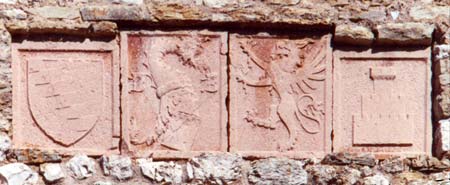
The current condition of the Tower remains adequate..1. I don’t believe the interior can be accessed without a ladder, since the old passage to it under the road has remained buried. On the west side of the Tower, the side that faces onto the Via Flaminia can be seen several coats-of-arms, among them those of Trevi, of Perugia, and of the Bishop Bardi (?) are in rather good condition.
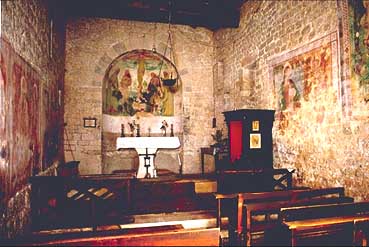
In a commandingly panoramic site despite its modest altitude, the church is particularly attractive by its elegant architecture, the precise construction of its walls, its interesting frescoes, and last but not least, because it preserves an ancient parchment giving us the date of its consecration: 1195.
Restored in 1928‑29, it now needs further work to repair the roof.
Water has infiltrated into the vault of the apse and has compromised the early 16th‑century fresco beneath it.
The interior
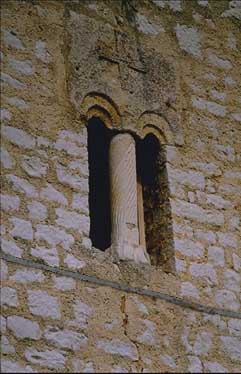
Bifora windows of the façade
The little arches of the bifora are a motif found in the apse of the ancient church of S. Emiliano
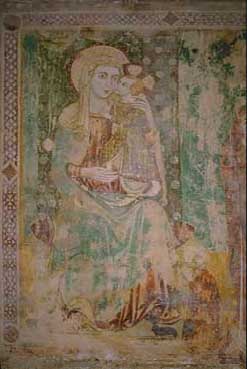
The Madonna and Child was dated by Nessi and attributed to a painter heretofore known only for the frescoes in S. Chiara at Montefalco and therefore referred to as the First Master of S. Chiara.